Children’s affirmations sound a bit intense, right? Let’s take a look.
First of all, repeat after me – I am a good parent, my child is happy, and I am doing my best.
Now read that again – in your head and then out loud. Finally, close your eyes and repeat those words – and let them really sink in.
Do this every time you doubt yourself or feel like you’re anything less than awesome.
A word about children’s affirmations
Affirmations for children are a relatively new creation, but they are proving to be a really helpful mental health tool for children and young people, as well as adults.
The concept of affirmations is as plain as they come – you read and repeat the words. And that’s exactly what makes this such an attainable and child-friendly method.
How can something so simple, bring about any meaningful change? It’s our old pal science again.
Affirmations are positive statements that can help you challenge negative and unhelpful thought patterns, and overcome self-sabotaging beliefs and behaviours. Done properly, they really do make a difference.
The active practice of affirmations involves reading and repeating a positive or reassuring phrase multiple times. It helps if you make this a part of your daily routine, but also if you have an affirmation on standby.
Neuroscience says that when it comes to affirmations, practice makes perfect (or, more accurately, less of a stressed-out, anxious mess).
Here’s a piece from PositivePhychology.com on the psychological theory behind positive affirmations:
“One of the key psychological theories behind positive affirmations is self-affirmation theory (Steele, 1988). So, yes, there are empirical studies based on the idea that we can maintain our sense of self-integrity by telling ourselves (or affirming) what we believe in positive ways.
Very briefly, self-integrity relates to our global self-efficacy – our perceived ability to control moral outcomes and respond flexibly when our self-concept is threatened (Cohen & Sherman, 2014). So, we as humans are motivated to protect ourselves from these threats by maintaining our self-integrity.”
Neuroscientific research continues to investigate whether we witness any physical changes in the brain when we self-affirm, but there is already substantial MRI evidence suggesting that certain pathways are increased when people practice self-affirmation tasks (Cascio et al., 2016). There is also an evidence-based theory that affirmations: decrease health-deteriorating stress (Sherman et al., 2009; Critcher & Dunning, 2015); may help us to perceive otherwise “threatening” messages with less resistance, including interventions (Logel & Cohen, 2012); make us less likely to dismiss harmful health messages, responding instead with the intention to change for the better (Harris et al., 2007); and have been linked to improved academic achievement by mitigating GPA decline in students who say they ‘feel left out’ at college (Layous et al., 2017).
In broader terms, affirmations are known to bolster resilience and encourage us to speak and behave intentionally. They are regarded as an accessible method for practising mindfulness, gratitude and understanding.
So there you have it, the science tells us that practising positive affirmations – choosing our words kindly and carefully – makes a very real impact on our thoughts and behaviours. How’s that for words in action?
I write this as a self-confessed highly-awkward specimen of a human. The idea of looking in the mirror and telling myself that I am brilliant and giving myself some sort of weird 1-1 team talk before I go about my day makes me wretch and shudder.
Thankfully there is no rule book on how and when you use affirmations to reassure and lift yourself or your child. In our house, I personally use affirmations when I’m about to make a phone call that I don’t want to make, when I am invited to an event that requires public speaking, or when I feel utterly overwhelmed and anxious.
When it comes to children’s affirmations, up until a certain age, they are far less self-conscious and much more open to playful techniques. Introducing age-appropriate affirmations at this age can make a huge difference to their mindset as they start to face all the usual challenges of childhood.
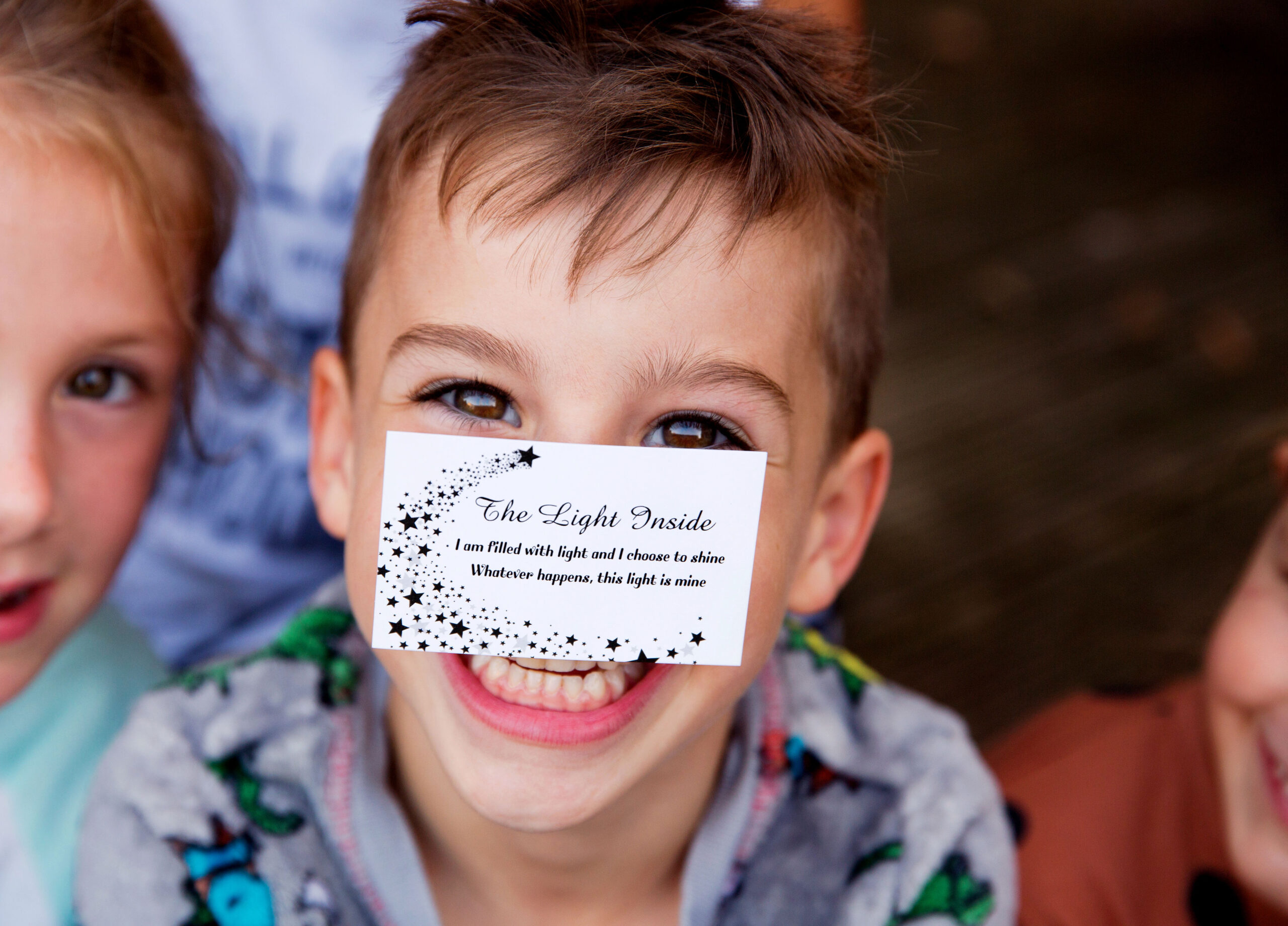
In our hallway, we’ve created a cheer board loaded with positive (cringe) and motivational family-friendly messages. In other words – it’s loaded with what are essentially children’s affirmations – in the form of Batman quotes, etc. It is the last thing my sons see in the morning and the first thing they come home to. We’ve got a calendar of short daily children’s affirmations right next to the front door, and my youngest son reads these every day before school. There’s a pack of children’s affirmation cards in the car, and we pull one at random a couple of times a week. We also have our own in-car mantra which my son and I say together on the way to school. It goes like this “Wherever I’m going, whatever I’m doing, I try my best, to be my best”. Go ahead and give it a try – or come up with one of your own. You could say that I believe in affirmations!
Oh, and don’t forget – I am a good parent, my child is happy, and I am doing my best.
All Picture-This Books™ titles include uplifting and reassuring affirmations to guide children through the book and remind them how special and able they are.